Todos los alumnos de 2ESO que no tienen que ir a la recuperación final han recibido sus calificaciones en su dirección de correo electrónico.
Os he enviado, además, un formulario para que valoréis mi trabajo.
Muchas Gracias
viernes, 29 de mayo de 2020

domingo, 24 de mayo de 2020
Work for week 25 May. Watch out, early due date!!!!
Hello everyone, this is our last week of work in the ordinary period.
This will be the last activity included in the 3rd term.
I am waiting to receive instructions regarding activities for the extraordinary period so, please, keep an eye on our blog.
Aren´t you happy!?
Only one thing to do this week:
2B: Game PIN: 09842608
2C:Game PIN: 08481451
2D:Game PIN: 06988829
Solo para los despistados que no hicieron algunos kahoots:
Os envío un mensaje a vuestro correo electrónico si no hicisteis alguno de ellos.
Due date: Wednesday 27 May 12:00 pm (noon)
Gothic: Game PIN: 01419478
Economy and society: Game PIN: 09117781
This will be the last activity included in the 3rd term.
I am waiting to receive instructions regarding activities for the extraordinary period so, please, keep an eye on our blog.
Aren´t you happy!?
Only one thing to do this week:
1. Make this kahoot about what we have studied about The Late Middle Ages (unit 7) before Wednesday 27 May at 12:00pm (noon)
2B: Game PIN: 09842608
2C:Game PIN: 08481451
2D:Game PIN: 06988829
Solo para los despistados que no hicieron algunos kahoots:
Os envío un mensaje a vuestro correo electrónico si no hicisteis alguno de ellos.
Due date: Wednesday 27 May 12:00 pm (noon)
Gothic: Game PIN: 01419478
Economy and society: Game PIN: 09117781
lunes, 18 de mayo de 2020
AVISO IMPORTANTE PARA LOS ALUMNOS DE 2 ESO CON EVALUACIONES SUSPENSAS
Estimad@s alumn@s de la asignatura de Geography and History 2 ESO
Os hago llegar este mensaje para informaros de cuestiones muy importantes para los alumnos que hayan suspendido la primera y/o la segunda evaluación.
1. Como sabéis, aquellos que al acabar la tercera evaluación no tengan una nota media del curso superior al 5 tendrán dos nuevas oportunidades para aprobar.
- La primera oportunidad es la recuperación final, en la que os examinaréis de los contenidos de las evaluaciones que hayáis suspendido. Dicho examen de recuperación final tendrá lugar entre el lunes 1 de junio y el 3 de junio (dependiendo del grupo en el que estés)
Los que hayáis suspendido evaluaciones anteriores tendréis que ir estudiando ya para poder estar preparados (es difícil que superéis la asignatura aunque tengáis una buena nota en 3ª evaluación si vuestras notas de la 1ª y la 2ª eran muy bajas, haced vuestros cálculos o escribidme). De cualquier forma yo os comunicaré lo antes posible tanto el resultado de la 3ª evaluación como vuestra nota media de curso.
- La segunda oportunidad será la evaluación extraordinaria, cuya fecha exacta aún no se ha fijado, pero que se realizará probablemente durante la semana del 8-12 de junio. Los que acudáis a este examen por no haber superado el de recuperación final os tendréis que examinar de todos los contenidos del curso.
Os hago llegar este mensaje para informaros de cuestiones muy importantes para los alumnos que hayan suspendido la primera y/o la segunda evaluación.
1. Como sabéis, aquellos que al acabar la tercera evaluación no tengan una nota media del curso superior al 5 tendrán dos nuevas oportunidades para aprobar.
- La primera oportunidad es la recuperación final, en la que os examinaréis de los contenidos de las evaluaciones que hayáis suspendido. Dicho examen de recuperación final tendrá lugar entre el lunes 1 de junio y el 3 de junio (dependiendo del grupo en el que estés)
Los que hayáis suspendido evaluaciones anteriores tendréis que ir estudiando ya para poder estar preparados (es difícil que superéis la asignatura aunque tengáis una buena nota en 3ª evaluación si vuestras notas de la 1ª y la 2ª eran muy bajas, haced vuestros cálculos o escribidme). De cualquier forma yo os comunicaré lo antes posible tanto el resultado de la 3ª evaluación como vuestra nota media de curso.
- La segunda oportunidad será la evaluación extraordinaria, cuya fecha exacta aún no se ha fijado, pero que se realizará probablemente durante la semana del 8-12 de junio. Los que acudáis a este examen por no haber superado el de recuperación final os tendréis que examinar de todos los contenidos del curso.
domingo, 17 de mayo de 2020
Work for week 18-22 May
Hello, wonderful people!!!
This week we are continuing with unit 7 about the Late Middle Ages. We are studying a bit of what happened in the Nasrid kingdom as well as some important features of the politics in the Christian kingdoms in that period.
You will have to do activities 6 and 7 of unit 7 (already published).
Please make sure that you start soon enough to send me homework complete before 22 May at 12:00 pm (noon)
This week we are continuing with unit 7 about the Late Middle Ages. We are studying a bit of what happened in the Nasrid kingdom as well as some important features of the politics in the Christian kingdoms in that period.
You will have to do activities 6 and 7 of unit 7 (already published).
Please make sure that you start soon enough to send me homework complete before 22 May at 12:00 pm (noon)
lunes, 11 de mayo de 2020
Work for week 11-14 May
Hello again, beautiful people!!
Have you already gone out for a walk?... You should : )
2 activities for this week + a new opportunity for those who didn´t do the kahoot on Gothic
1. You are going to take a Kahoot to finish unit 6. It´s about economy and society in the High Middle Ages
Game PIN for 2B: 05730887
Game PIN for 2C: 01613135
Game PIN for 2D: 06755913
2. We continue with unit 7.
This is your turn to do a little research on the Black Death. Do activity 5 of unit 7 (already published in our blog)

All these activities and the kahoot must be done and turned in before Thursday 14th at 12:00 pm.
Only for those of you who did not take the Kahoot on Gothic Art last week you have a new oportunity to do it!!!
Please remember to use nicknames as I told you. Deadline to take it is Thursday at 12:00 h.
Game PIN for 2B: 09109405
Game PIN for 2C: 09035413
Game PIN for 2D: 02456594
Have you already gone out for a walk?... You should : )
2 activities for this week + a new opportunity for those who didn´t do the kahoot on Gothic
1. You are going to take a Kahoot to finish unit 6. It´s about economy and society in the High Middle Ages
Game PIN for 2B: 05730887
Game PIN for 2C: 01613135
Game PIN for 2D: 06755913
2. We continue with unit 7.
This is your turn to do a little research on the Black Death. Do activity 5 of unit 7 (already published in our blog)

All these activities and the kahoot must be done and turned in before Thursday 14th at 12:00 pm.
Only for those of you who did not take the Kahoot on Gothic Art last week you have a new oportunity to do it!!!
Please remember to use nicknames as I told you. Deadline to take it is Thursday at 12:00 h.
Game PIN for 2B: 09109405
Game PIN for 2C: 09035413
Game PIN for 2D: 02456594
domingo, 3 de mayo de 2020
Work for week 4-8 May
Hello wonderful students!!!
You have some things to do:
1. This week you are going to take a Kahoot on Gothic art (If you did the activities regarding architecture, sculpture and painting you are going to do very good : )
Please remember to use nicknames as I told you. Deadline to take it is Friday at 12:00 h.
Game PIN for 2B: 04241975
Game PIN for 2C: 04940110
Game PIN for 2D: 04428021
2. You also have to do activities 1-4 regarding a new unit.
You will find the activities in post about Unit 7: The Late Middle Ages. Crisis and recovery.
These activities must be in my email before Friday at 12:00h.
You have some things to do:
1. This week you are going to take a Kahoot on Gothic art (If you did the activities regarding architecture, sculpture and painting you are going to do very good : )
Please remember to use nicknames as I told you. Deadline to take it is Friday at 12:00 h.
Game PIN for 2B: 04241975
Game PIN for 2C: 04940110
Game PIN for 2D: 04428021
2. You also have to do activities 1-4 regarding a new unit.
You will find the activities in post about Unit 7: The Late Middle Ages. Crisis and recovery.
These activities must be in my email before Friday at 12:00h.
Unit 7. The Late Middle Ages. Crisis and recovery
Act.1 Copy these mind-maps in your notebook. I am sure you can do better than me (but I thought you might be missing my drawings).
 |
| Mind-map 1. An introduction to the whole unit |
 |
| Mind-map 2. Europe in the 14th and 15th c. |
Act.2 Once you have copied the mind-maps, listen to this audios with some explanations. (Take little notes in your mind-map where necessary)
Audio: Introduction of unit 7 (mind-map1)
Audio: Europe during the Late Middle Ages (mind-map 2)
Act.3 Which centuries do the Late Middle Ages comprise?
Act.4 Write a text that explains both mind-maps (You already know this: intro/body/conclusion)
- Mind-map 1 is the Introduction to the unit
- Mind-map 2 is the part of the unit related to Europe
Act. 5. Research on the Black Death
You will have to research to find the most important features to this event that was one of the most important epidemics of the past.
- You can start by reading your textbook (pages 132-133)
- After that go to page 145 to find the structure that your report should have "Presenting a report"
- Once you have done those you can start your research. There are tons of videos, magazines and articles in the Internet that will be useful. Your book gives you some ideas on where to start.
- When you start reading about this plague you will probably start making questions to yourself; try to answer to those questions in your report. (Where did it come from?, why did so many people die?, why did it spread so fast?, what symptoms did people have?, is it similar to the epidemic we are living today? ...)
- Of course it would be fantastic to see pictures or maps that illustrate the topic.
- You can turn in it in the way that is most convenient to you (picture of the notebook to my email or drive, etc)
- I want to remind you that if you copy literally from the Internet or from any other source I will not be able to accept your work.
The late Middle Ages in Al-Andalus. The Nasrid kingdom
Act. 6. Listen to this audio and then copy the mind-map. If you have any problem with the audio try this link.
You have to incorporate to your mind-map some information that is missing in it (some of the information you may find in my audio, but you might have to do some research to find some other answers : )
- Why did the Nasrid kingdom have internal conflicts?
- why did they have a flourishing economy?
- which circumstances enabled the Nasrid kingdom to survive for so long?
- What is the Alhambra?
- Why and how did Al Andalus finally disappear?
 |
| Mind-map 3. The Late Middle Ages in al-Andalus. The Nasrid Kingdom of Granada |
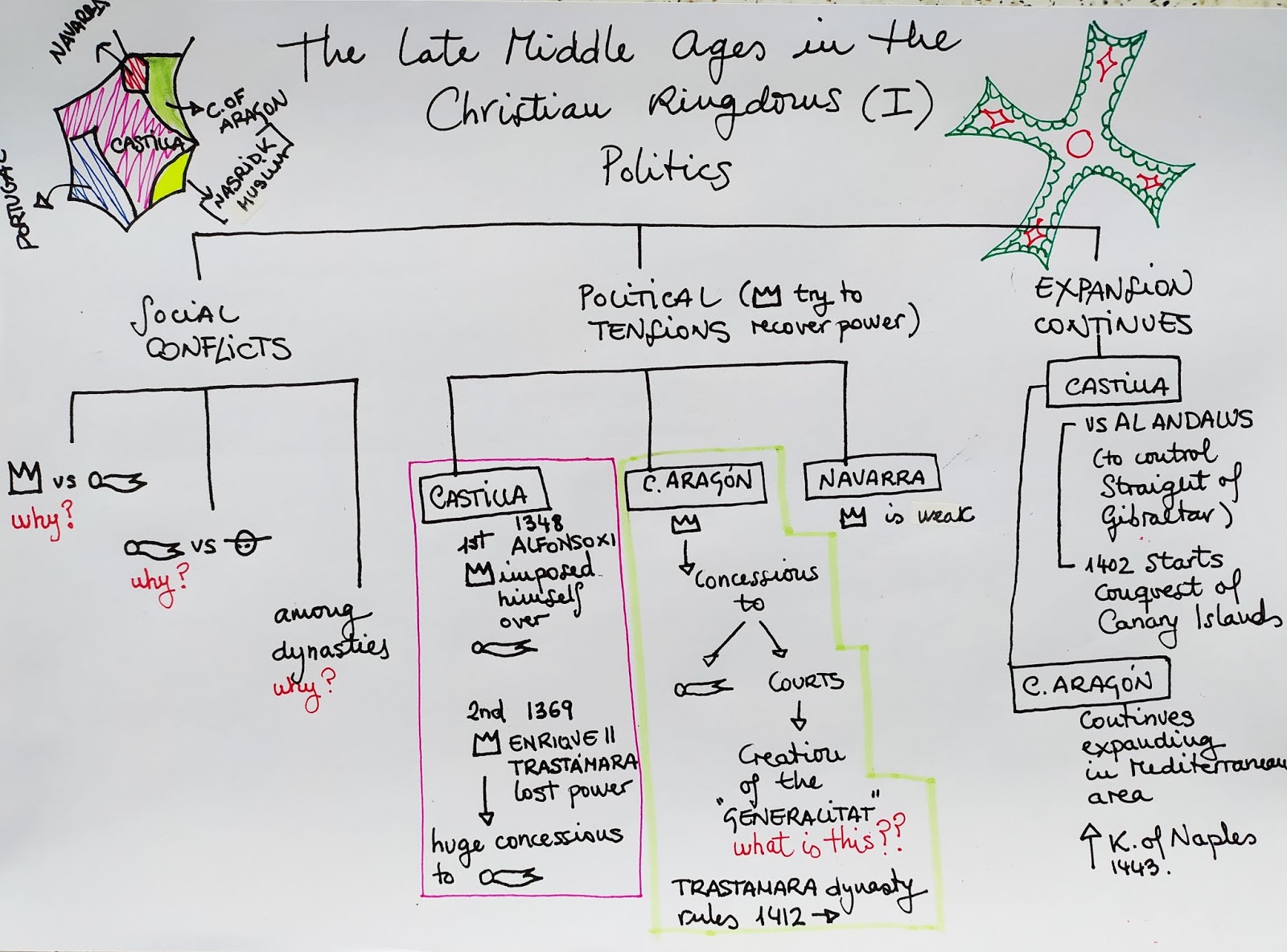
The Late Middle Ages in the Christian kingdoms (I) Politics
We are going to pay attention now to the Christian kingdoms in the Iberian Peninsula during the 14th and 15th c.
Act. 7. 1 Listen to this audio and then copy the mind-map. If you have any problem with the audio try this link.
You have to incorporate to your mind-map some information that is missing in it (some of the information
Act. 7.2 Write a text to explain the mind-map
domingo, 26 de abril de 2020
New assessment criteria for Geography and History ESO / Nuevos criterios de evaluación y calificación para Geografía e Historia ESO
A continuación os comunico cuáles van a ser los nuevos criterios de calificación y evaluación para nuestra asignatura.
Todas estas modificaciones se han hecho para tener en cuenta la peculiar situación de esta tercera evaluación del curso 1919-2020 y en consonancia con las indicaciones recibidas de la Consejería de Educación de Madrid.
Audio con aclaraciones
Todas estas modificaciones se han hecho para tener en cuenta la peculiar situación de esta tercera evaluación del curso 1919-2020 y en consonancia con las indicaciones recibidas de la Consejería de Educación de Madrid.
Audio con aclaraciones
Work for week 27th April-1st May
Helloooooo beautiful people!!!!
We are going to finish unit 6
You need to do activities 3.1, 3.2 and 4 and send them to me before Friday 1 May.
They are published here, in the post about unit 6.
We are going to finish unit 6
You need to do activities 3.1, 3.2 and 4 and send them to me before Friday 1 May.
They are published here, in the post about unit 6.
domingo, 19 de abril de 2020
Work for week 20-24 April
Dearest students,
There we go with new activities for this week.
1. Do activities 13.2 and 13.3 included in Unit 5 (already posted in our blog) and send them to me before Friday 24th 15:00h.
(Here is the link to the post of unit 5)
2. Now you can correct your table about the Romanesque and Gothic architecture yourselves by looking at this table I made for you. Click on this link. Of course I will no longer give you scores if you send this activity to me from now on.
3. Please take a look at a previous post: I cannot recognize some nicknames; please send me an email if you see your nickname in that post.
Only for those of you who didn´t make last week kahoots:
- You can take the kahoot of Unit 5 until Friday 24 April 15:00h. Here is your pin: 02871260
- You can take the kahoot of Unit 6 until Friday 24 April 15:00h. Here is your pin: 04385117
Most of you are doing a wonderful job : )
Many many many kisses
There we go with new activities for this week.
1. Do activities 13.2 and 13.3 included in Unit 5 (already posted in our blog) and send them to me before Friday 24th 15:00h.
(Here is the link to the post of unit 5)
2. Now you can correct your table about the Romanesque and Gothic architecture yourselves by looking at this table I made for you. Click on this link. Of course I will no longer give you scores if you send this activity to me from now on.
3. Please take a look at a previous post: I cannot recognize some nicknames; please send me an email if you see your nickname in that post.
Only for those of you who didn´t make last week kahoots:
- You can take the kahoot of Unit 5 until Friday 24 April 15:00h. Here is your pin: 02871260
- You can take the kahoot of Unit 6 until Friday 24 April 15:00h. Here is your pin: 04385117
Most of you are doing a wonderful job : )
Many many many kisses
viernes, 17 de abril de 2020
Problema con algunos nicknames
Hola preciosísim@s,
Muchos de vosotros habéis completado ya algún Kahoot.
Os pido que tengáis cuidado con los nicknames... me estoy volviendo más majareta de lo que ya estaba.
Aquellos que hayáis utilizado los nicknames que publico a continuación tenéis que escribirme a mi correo diciéndome quiénes sois. En el asunto ponéis: nickname kahoot ¿vale?
Los demás no tenéis que hacer nada más.
No sé quiénes son:
Caso
Alejandro
Jala
Fede
Ln
Kmpo
Muchos de vosotros habéis completado ya algún Kahoot.
Os pido que tengáis cuidado con los nicknames... me estoy volviendo más majareta de lo que ya estaba.
Aquellos que hayáis utilizado los nicknames que publico a continuación tenéis que escribirme a mi correo diciéndome quiénes sois. En el asunto ponéis: nickname kahoot ¿vale?
Los demás no tenéis que hacer nada más.
No sé quiénes son:
Caso
Alejandro
Jala
Fede
Ln
Kmpo
lunes, 13 de abril de 2020
Back to work after Easter Vacation. Work for week 14-17 April
-Kahoot exercise must be completed before Wednesday 15th 12:00 pm.
-This is your pin 0978309
-You must identify yourselves with a nickname following this instructions: Your nickname will be as follows: (two first letters of your first name)+(two last letters of your last name)
My nickname would be: "panz".
-You can either download the application on your mobile phone or play in your web browser: https//:kahoot.it
- If you are using your phone, make sure it has full batteries.
- You must have your notebook and book with you when you complete this kahoots.
Got it??
You will get a grade for this exercise, so don´t forget to do it on time.
2. You need to make a kahoot about points 1-5 of unit 6 of your textbook.
-Kahoot exercise must be completed before Thursday 16th 12:00 pm.
-This is your pin 01836321
- You must have your notebook and book with you when you complete this kahoots.
You will get a grade for this exercise, so don´t forget to do it on time.
Please, email me if you find any difficulties.
3. Here we go with a new explanation. It belongs to unit 5... we didn´t have time to do it in class so here we go with GOTHIC ART!!
a) You must listen to the audio files and look at the pictures at the same time to understand.
b) You have to listen to it several times and take notes (tomar apuntes) because I want you to make activity 13.1 of unit 5 after you finish listening (you can find it here)
You must send me your exercise before friday 17th April. You might want to try doing the table with word using "tables". Its quite easy if you do it that way, but you can also do it in paper and send me a picture (I recommend landscape mode : )
Audio 1. Gothic architecture.
Remembering Romanesque architecture and learning about the new style: Gothic
 |
| Picture 1: Features of Romanesque architecture |
 |
| Picture 2: Features of the Gothic architecture |
jueves, 2 de abril de 2020
Aviso importante para Geography and History 2 ESO
1. POSIBLE CAMBIO DE CRITERIOS DE CALIFICACIÓN PARA LA TERCERA EVALUACIÓN
Como aún no sabemos cuándo volveremos a clase, el Departamento de Geografía e Historia del IES Luis García Berlanga está estudiando la posibilidad de hacer un cambio en los criterios de calificación de la asignatura para la tercera evaluación para dar más peso a la entrega de las actividades que aquella que figuraba en vuestras programaciones de inicio de curso.
Por ello os animamos a que os pongáis al día durante las vacaciones de Semana Santa terminando y entregando todas las actividades en la forma en la que os las haya pedido vuestro profesor.
2. POSIBLE REALIZACIÓN DE EXÁMENES ONLINE
Para evitar que se vayan acumulando temas, es probable también que empecemos a haceros exámenes online a través de aplicaciones como Kahoot. Deberíais descargároslo en vuestro móvil (es gratuito) así es que si tenéis alguna duda sobre el contenido de la asignatura, preguntad a vuestr@ profesor@.
No debéis preocuparos si ya estáis trabajando; entendemos que casi tod@s estáis trabajando muy bien y que estáis aprendiendo muchas cosas.
¡Mucho ánimo para tod@s!
Departamento de Geografía e Historia del IES Luis García Berlanga, Coslada.
lunes, 30 de marzo de 2020
Work for week March 30- April 2
Hello everyone, here you are the activities that you should do this week.
I hope everybody is alright.
You don´t need to send them to me but they sure need to be in your notebook. I will ask you to send me all the activities later on.

Remember you can always ask me questions by writing to my email.
We are going to continue on unit 6. Please copy questions and answers in yout notebook.
The Peninsular monarchies
Act. 3.1a
Read 3.1. After that listen to this audio file.
Read point 3.1 in your book. I have detected the main ideas for you. You only have to set them in the form of a mind-map.
peninsular kings power diminished by nobles (fiefdoms or manors) and cities
Differences in the authority the king had
Castilla unitary monarchy greater authority (king didn´t have to make pacts with Courts)
Crown of Aragon (Corona de Aragón) Aragón, Catalonia, Mallorca, Valencia each one had its own institutions
pact-based system (pactismo)
Act. 3.1b
Read The following texts and answer to the questions
 1. 1 Alfonso X believed that the power of the king came from ...
1.2. Do you think people would respect more the authority of the king if they thought his power came from God? why?
1.3 Who is Pedro II talking to in text B?
1.4 What did the king of the Crown of Aragon have to do if he wanted to make a law in the Crown of Aragon?
1.5 How do we call the system by which the king had to make an agreement with "Las Cortes" of the different kingdoms to change laws?
2. Read the following text and take a look at the illustration to answer to the questions:


2.1 Who are those people marked with number 3 in the illustration? To what estates do they belong?
2.2 Where and when were the first Courts celebrated?
2.3 How did the king summon them to Courts?
2.4 Which were generally the intentions of the king when he summoned Courts?
Act. 3.2. Institutions: Curia, Courts and Councils
Listen to this audio file.
Act. 4.1 Council or municipal repopulation
Listen to this audio file.
Make a mind map in your notebook.
Act. 4.2. Repopulation by the military orders
Listen to this audio file.
Make a mind map in your notebook.
Act. 4.3 Repopulation by repartimiento
Listen to this audio file.
Make a mind map in your notebook.
Act. 4.4 Now, answer to the following questions:
a. What is a charter?
b. Where was the council repopulation used?
c. What did each council get?
d. Why did knights receive a larger plot of land?
e. Where was the repopulation by the military orders used? Why?
f. How did they call the territories that the military orders got?
g. Where was the repartimiento system used? did everybody receive plots of the same size? why?
h. Read this text about the Charter or Code of Cuenca and answer to the questions:
 h1. Did people owning a house in the city of Cuenca have to pay taxes?
h2. Did people living in the council of Cuenca have to pay when they inheritate anything?
h3. The city of Cuenca was given a very important privilege when they were allowed to celebrate a fair (feria). Why do you think it was so important for the city?
Act 4.5 Now describe the first map in page 119: Repopulation of the Peninsula
(Don´t forget to mention the different kingdoms in the Peninsula)

Act 4.6 Take a look at the map about the military orders.

a. Which were the main military orders in the Kingdom of Castilla?
b. By looking at the map, which areas of Castilla do you think were the most dangerous at the time? why?
b. Which were the main military orders in the Crown of Aragon?
I hope everybody is alright.
You don´t need to send them to me but they sure need to be in your notebook. I will ask you to send me all the activities later on.
I am missing you very very very very very very much.
Is that clear?
Remember you can always ask me questions by writing to my email.
We are going to continue on unit 6. Please copy questions and answers in yout notebook.
The Peninsular monarchies
Act. 3.1a
Read 3.1. After that listen to this audio file.
Read point 3.1 in your book. I have detected the main ideas for you. You only have to set them in the form of a mind-map.
peninsular kings power diminished by nobles (fiefdoms or manors) and cities
Differences in the authority the king had
Castilla unitary monarchy greater authority (king didn´t have to make pacts with Courts)
Crown of Aragon (Corona de Aragón) Aragón, Catalonia, Mallorca, Valencia each one had its own institutions
pact-based system (pactismo)
Act. 3.1b
Read The following texts and answer to the questions

1.2. Do you think people would respect more the authority of the king if they thought his power came from God? why?
1.3 Who is Pedro II talking to in text B?
1.4 What did the king of the Crown of Aragon have to do if he wanted to make a law in the Crown of Aragon?
1.5 How do we call the system by which the king had to make an agreement with "Las Cortes" of the different kingdoms to change laws?
2. Read the following text and take a look at the illustration to answer to the questions:


2.1 Who are those people marked with number 3 in the illustration? To what estates do they belong?
2.2 Where and when were the first Courts celebrated?
2.3 How did the king summon them to Courts?
2.4 Which were generally the intentions of the king when he summoned Courts?
Act. 3.2. Institutions: Curia, Courts and Councils
Listen to this audio file.
Act. 4.1 Council or municipal repopulation
Listen to this audio file.
Make a mind map in your notebook.
Act. 4.2. Repopulation by the military orders
Listen to this audio file.
Make a mind map in your notebook.
Act. 4.3 Repopulation by repartimiento
Listen to this audio file.
Make a mind map in your notebook.
Act. 4.4 Now, answer to the following questions:
a. What is a charter?
b. Where was the council repopulation used?
c. What did each council get?
d. Why did knights receive a larger plot of land?
e. Where was the repopulation by the military orders used? Why?
f. How did they call the territories that the military orders got?
g. Where was the repartimiento system used? did everybody receive plots of the same size? why?
h. Read this text about the Charter or Code of Cuenca and answer to the questions:

h2. Did people living in the council of Cuenca have to pay when they inheritate anything?
h3. The city of Cuenca was given a very important privilege when they were allowed to celebrate a fair (feria). Why do you think it was so important for the city?
Act 4.5 Now describe the first map in page 119: Repopulation of the Peninsula
(Don´t forget to mention the different kingdoms in the Peninsula)

Act 4.6 Take a look at the map about the military orders.

a. Which were the main military orders in the Kingdom of Castilla?
b. By looking at the map, which areas of Castilla do you think were the most dangerous at the time? why?
b. Which were the main military orders in the Crown of Aragon?
sábado, 21 de marzo de 2020
Solutions to activities U. 6
Hi everyone!
Here you can find solutions to correct the activities that you did on unit 6. I made some audio files so you can easily listen to them if you are working only with the help of a celular phone or don´t have a very good conexion.
Kisses for all
Mil besos
Solutions to activity 1
Solutions to activity 2
Solutions to activity 2.3
Solutions to activity 2.4a
Solutions to activity 2.4b
Solution to mind-map conquests Crown of Aragon
Summary of points 1 and 2 of unit 6
Here you can find solutions to correct the activities that you did on unit 6. I made some audio files so you can easily listen to them if you are working only with the help of a celular phone or don´t have a very good conexion.
Kisses for all
Mil besos
Solutions to activity 1
Solutions to activity 2
Solutions to activity 2.3
Solutions to activity 2.4a
Solutions to activity 2.4b
Solution to mind-map conquests Crown of Aragon
Summary of points 1 and 2 of unit 6
jueves, 19 de marzo de 2020
¡Ánimo chic@s!
Tenéis que ir organizándoos.
Muchos no me habéis mandado el trabajo sobre "Changes in the High Middle Ages"... por favor, mandadlo en cuanto podáis.
Tenéis que seguir trabajando con el tema 6.
Espero que estéis bien.
Muchos besos
Muchos no me habéis mandado el trabajo sobre "Changes in the High Middle Ages"... por favor, mandadlo en cuanto podáis.
Tenéis que seguir trabajando con el tema 6.
Espero que estéis bien.
Muchos besos
lunes, 16 de marzo de 2020
Unit 6. The Iberian Peninsula between the 11th and 13th centuries.
1. UNIT PRESENTATION
Title
The Iberian Peninsula between the 11th and 13th centuries
Unit description
The unit devoted to the High Middle Ages in
the Iberian Peninsula, following the same schedule used for the Early Middle
Ages, is structured in two parts. The first one analyses the progressive
decline of al-Andalus during the Taifa, Almoravid and Almohad periods; and
their artistic expressions. the second part studies the consolidation and
advance of the peninsular Christian Kingdoms: the territorial expansion of the
different kingdoms; the political organisation and the introduction of new
institutions such as Courts; the methods for repopulating territories conquered
from al-Andalus; the social organisation; the cultural revival; the Gothic
artistic expressions until the 13th century, and Mudejar art. The
technique of creating an historical biography promotes the historian profession
and allows increasing the knowledge of relevant characters of the corresponding
historical time.
The various activities presented
throughout the unit are designed to help students acquire knowledge on the following:
- The political and territorial decline of
al-Andalus (1031-1224). Artistic evolution.
- Consolidation and advance of the Christian
kingdoms.
- Government and administration of the Christian
kingdoms.
- The repopulation of the conquered territory.
- Economic activities of the Christian kingdoms.
- Estate-based society and ways of life.
- The culture and art of the Christian kingdoms.
Gothic and Mudejar art.
- The autonomous community between the 9th
and 13th centuries.
- How to create an historical biography.
-
Checking progress
in the development of some core competences.
2. TEACHING OBJECTIVES
1. To explain al-Andalus historical and artistic
evolution between 1031 and 1224.
2. To identify the foundations of the
consolidation and advance of the Christian kingdoms.
3. To distinguish the differences existing in the
government and administration of the Christian kingdoms.
4. To draw conclusions of the repopulation models.
5. To differentiate the economic activities of
the Christian kingdoms.
6. To make interpretations on the three-estate
system and the ways of life of each estate.
7. To make conceptual networks on peninsular
Gothic art and Mudejar art.
8. To appreciate the historical singularity of
their autonomous community between the 9th and 13th centuries.
9. To learn how to make an historical biography.
10. To
promote the development of the core competences.
Activities
In this unit we go back to the Iberian Peninsula for the period of the High Middle Ages.
Remember we have studied two civilisations sharing the space of the Peninsula: the Christian kingdoms in the north and Al Andalus in the south.
In this period many changes ocurred:
- Al Andalus suffers a period of instability due to the African invasions. New empires (the Almoravids and Almohads) invade the territory of Al Andalus.
- Christian kingdoms slowly advance in the territory.
- Al Andalus suffers a period of instability due to the African invasions. New empires (the Almoravids and Almohads) invade the territory of Al Andalus.
- Christian kingdoms slowly advance in the territory.
Read carefully and copy questions and answers in your notebook.
Activities 1 and 2 should be done by next Friday March 20th.
You don´t need to send them to me, but please, make them properly. I will ask you to do some activity (similar to the one you did for unit 5) to find out if you really understood what you studied.
You don´t need to send them to me, but please, make them properly. I will ask you to do some activity (similar to the one you did for unit 5) to find out if you really understood what you studied.
1. The political and territorial decline of Al Andalus
This is a period of decline and many changes in Al Andalus.
Read point 1 of your book and do the following exercises:
1.1 Answer these questions
a) Order the following and add the corresponding dates to each one: Nasrid Kingdom of Granada, second taifa period, first taifa period, Almoravid rule, Almohad rule, Battle of Navas de Tolosa, third taifa period
b) Make a timeline in your notebook (remember: landscape mode, scale, space for the Christian kingdoms)
1.2. Complete the following sentences to understand the first taifas period and the rule of the Almoravids
a) The first taifas period was a moment of decline in Al Andalus. Christian kings took advantage of it and ...
b) During this period Alfonso VI, king of León conquered ... in the year ...
c) The conquest of Toledo created great alarm among the Muslims of Al Andalus. That is why andalusians called the ...
d) The Almoravids defeated Alfonso VI in the battle of ... and (although they had come to help the governorns of the Taifas) imposed their rule in Al Andalus.
e) One of the most outstanding features of Almoravids was their religious ... (they were not tolerant with Mozarabs and Jews)
f) By 1145 Almoravids had lost authority and disintegrated into the ...
1.3 Complete the following sentences to understand the first taifas period and the rule of the Almohads
a) While the Almoravids were ruling in the Iberian Peninsula a new tribe was gaining power in Africa. These peoples were the Almohads. In 1147 they entered in ... and implemented a greater ...
b) The battle of ... in year 1212 was decisive for the Christian kingdoms. Little by little the Almohad power declined and Al Andalus started a new ... period.
c) From year ... until year ... Muslims only ruled in a small territory in the peninsula. It was called the Nasrid Kingdom of Granada.
2. Consolidation and advance of the Christian kingdoms
During this period the situation in Al Andalus is not good. That is why Christian kingdoms take advantage of it (aprovechan) to gain some land to the Muslims. Only Navarra (it was called kingdom of Pamplona before) didn´t advance in the territory.
2.1 The Kingdoms of Castilla and León
Answer these questions:
a) What important event took place in 1230?
b) In year 1085 Alfonso VI, king of León, reached river ...
c) In the 13th c., after defeating the ... in the Battle of Navas de Tolosa Castilla and León incorporated ... and ...
Now look at the map in page 115
a) Read the legend carefully
b) Can you see the battle of Navas de Tolosa in the map? Where did it take place?
c) What important andalusian cities were conquered after that date?
d) Can you see the Nasrid Kingdom of Granada in the map? Which nowadays provinces did it include?
2.2 The Eastern states and kingdoms
Answer these questions:
a) What states did the Crown of Aragon include in 1137?
b) Make a simple mind-map of the conquest of the Crown of Aragon2.3 The kingdom of Portugal
a) Which do you think is the most important idea of this text?
2.4 Now do the following:
a) How many states were there in the Iberian Peninsula by the end of the High Middle Ages?
b) Describe the map in page 115.
3. Economic activities of the Christian kingdoms (Point 5 of your book)
3.1 The transhumance system (la trashumancia) and the Honourable Council of the Mesta (5.1 in your book)
Here you are an audio with some explanations.
a) Explain what was the transhumance
b) Explain what was the Honourable Council of the Mesta.
c) Explain why transhumance was so important for the economy of Castilla.
d) Explain why did kings of Castilla protect the transhumance system.
3.2 The urban activities (5.2 in your book)
We will focus on trade which brings some news to both Castilla and the Crown of Aragón. (Trade and trade hubs in your book)
Here you are an audio with some explanations.
a) Explain which were the areas in which trade developed in Castilla and what goods they imported and exported.
b) Which is the main geographical area in which the Crown of Aragon is trading during the High Middle Ages? (Take a look at map in page 121)
4. Estate-based society and ways of life. We are going to focus on some area we still didn´t speak about (6.3: Jews, Mudejars, vagrants and beggars)
Here you are an audio with some explanations.
The estate-based society continues all throughout this period in the Iberian Peninsula (remember: privileged and non privileged people / separate estates determined by birth from which people could hardly escape). There were also some other groups living in the Iberian Peninsula. Listen to this audio to understand who they were and how they lived.
a) Define: aljamas, Mudejars
b) Which were the main professions of Jews during this period?
domingo, 15 de marzo de 2020
¡¡¡Por favor revisad a qué dirección de correo estáis enviando los trabajos!!!!
Tenéis que tener cuidado al escribirla. Estáis enviando correos a otra persona que no soy yo.
Fijaos bien en el post en el que os pido la entrega de trabajo
Fijaos bien en el post en el que os pido la entrega de trabajo
miércoles, 11 de marzo de 2020
Activities week 9-13th March. Main changes during the High Middle Ages
Hi dearest students,
This week you will have to make a very special exercise.
You will have to write a long extension text about the Main changes during the High Middle Ages. It will be, more or less, an organised summary of what we studied in unit 5.
Before doing so you should review everything we studied in the past weeks regarding unit 5.
You will have to follow the structure that we use all the time:
Introduction: explain the general context of the High Middle Ages (when, were, general overview of the previous situation)
Body of text: (use linking words Tiff tought us!!)
Use different paragraphs to explain the different areas that suffer major changes:
- Agriculture and agrarian techniques
- Population
- Parliaments
- Cities
- Society
- Crafts
- Trade
- New religiosity
Conclusion: you know there are many possibilities: summarize the most important ideas.
Criteria:
- Follow the structure
- Explain (not just name) every idea
- Use the key words of the unit
- Watch your spelling
- Send it to my email before Saturday 14th march (That means Friday is your last day to send it)
 I have enabled comments in our blog, so you can also make questions or comment anything. Beware everybody will see it : )
Missing you already
This week you will have to make a very special exercise.
You will have to write a long extension text about the Main changes during the High Middle Ages. It will be, more or less, an organised summary of what we studied in unit 5.
Before doing so you should review everything we studied in the past weeks regarding unit 5.
You will have to follow the structure that we use all the time:
Introduction: explain the general context of the High Middle Ages (when, were, general overview of the previous situation)
Body of text: (use linking words Tiff tought us!!)
Use different paragraphs to explain the different areas that suffer major changes:
- Agriculture and agrarian techniques
- Population
- Parliaments
- Cities
- Society
- Crafts
- Trade
- New religiosity
Conclusion: you know there are many possibilities: summarize the most important ideas.
Criteria:
- Follow the structure
- Explain (not just name) every idea
- Use the key words of the unit
- Watch your spelling
- Send it to my email before Saturday 14th march (That means Friday is your last day to send it)

Missing you already
viernes, 14 de febrero de 2020
Unit 5. The High Middle Ages. Urban reinassance
UNIT PRESENTATION
Title
The High Middle Ages. Urban renaissance
Unit description
This unit analyses the changes experienced by
feudalism in Europe between the 9th and 13th centuries. Attention
is focused on the appearance of parliaments; on the advances carried out in
agricultural techniques; and, most of all, in the recovery of urban life,
stating the causes of this fact, the spatial organisation of cities, their
government bodies, the activities performed by craftsmen guilds and merchants, and
the features of the new urban society and everyday life in the city. The unit
closes with the analysis of the cultural renewal ¾appearance
of universities¾; the main features of religiosity
at the time ¾crusades, military orders, the
Inquisition and the mendicant orders¾; and the main architectural,
sculpture and pictorial expressions of Gothic art. The technique of analysing
works of art applies now to sculpture, providing a useful methodology for the
discussion of sculptures.
The various activities presented throughout the
unit are designed to help students acquire knowledge
on the following:
- The
European territory. A mosaic of kingdoms and nations.
- The
consequences of agricultural progress.
- Medieval
cities. Recovery, functions and spaces.
- Government
and economy in medieval cities.
- Society and
everyday life.
- Cultural
and religious renewal.
- Gothic
architecture.
- Gothic
sculpture, painting and stained glass.
- Analysing
works of art. Sculpture.
-
Checking progress
in the development of some core competences.
2. TEACHING OBJECTIVES
1. To distinguish the territorial scope and
political organisation of the High Middle Ages.
2. To list agricultural developments, their
causes and consequences.
3. To understand the renaissance, the functions
and spaces of the medieval city.
4. To differentiate the forms of government and
the economic activities of medieval cities.
5. To check the groups existing in the new urban
society and some aspects of their everyday life.
6. To understand and explain medieval urban
culture and religiosity.
7. To recognise Gothic architecture.
8. To analytically look at Gothic sculpture,
painting and stained glass windows.
9. To learn how to analyse a sculpture.
10. To promote the development of
the core competences.
Activities
1. Which centuries are included in the High Middle Ages?
2. Read the introduction of the unit in page 88 in your book.
State if the following are true or false. Make the corrections needed.
a) During the 11th c. agriculture was declining.
b) Therefore people didn´t have a lot to eat and many people died.
c) That is why we say economy was much worse than in the Early Middle Ages.
d) Some cities appeared and crafts and trade became more common.
e) The people that undertook the urban activities were called bourgeoisie.
f) In the cities cathedrals were built in a new style: Gothic style.
3. Agricultural progress
Read page 92.
3.1. Which was the main innovation during the 11th c. in agriculture?
3.2. Explain why the triennial rotation was a better crop rotation system.
 |
| Used before the 11th c. |
 |
| Used from the 11th c. |
5. Urban renaissance
Read 3.1. in your book. Why did new cities appear?
6. Who were the bourgeois?
7. What were the bourgeois dedicated to?
8. A new social group emerged with the renaissance of the cities and the appearance of the bourgeoisie. Draw a social pyramid of the High Middle Ages.
9. The medieval city or borough. Read 3.2 and draw a medieval city.
10. Economy.
Read 4.2.
What was a guild?
11. Political organisation. Parliaments.
Read 1.3.
11. 1 State if the following are true or false.
a) Until the 12th c. some people advised the king in an assembly called Curia Regis. Its members were part of the privileged groups (nobles and clergymen).
b) From the 12th/13th c. some other people were asked to join the assembly. These new members belonged to the bourgeoisie (non privileged) The new assembly was called Parliament.
11. 2 Listen to the explanation of the teacher and answer these questions.
a) Why did the king allow some non privileged people to join his assembly?
b) The king received ......................... from the Parliament. The members of the Parliament could present some ....................... to the king.
c) Is it true that kings always did what the Parliaments asked them to do?
d) How was the Parliament called in the Iberian Peninsula?
12. Cultural and religious renewal.

Read 6.2. in your book
12.1. Define the following. To do it use the following terms:
Crusades: Holy Land / military expeditions / Pope / 11th-13th c.
Military orders: monk-soldiers / defence / Holy Land / pilgrims / Kinghts Templar, Knights Hospitaller and Order of the Holy Sepulchre.
Inquisition: Court / judge / crimes against the Church / beginnning 13th c.
13. Gothic Art.
13.1 Make a table in your notebook comparing Gothic and Romanesque architecture.
The table should include the following: time /main buildings / Type of arch / height of the building / walls / windows / plan / area (rural or urban) / type of buttress / ceilings


13.2 Gothic sculpture
Read the following and make a table comparing the Romanesque and Gothic sculpture
It should include: stiff or certain movement / emotions and feelings / realistic or non realistic / subjetcs or topics / close to the wall or detached from the wall / features of the Crucified Christ / Features of Virgin Mary with Jesus
I advise you to make your table in a digital format and incorporate some pictures with examples of sculpture to it. Using tables is quite simple and helpful :) give it a try!!!
Please, pay attention to pictures and legends published here.


 |
| Besides the image of Virgin Mary with Jesus a new kind of representation was used. It is called "pietà" and it represents Virgin Mary holding her son Jesus after his death. |

a) Define the following: stained glass windows (vidrieras), altarpieces (retablos)
b) Which are the functions of the stained glass windows? Make a simple mind-map to explain. You can find that information in your book.
b) What are the functions of an altarpiece? For this you have to do some research and think a bit : ) Make a simple mind-map to explain.
b) Which are the functions of the stained glass windows? Make a simple mind-map to explain. You can find that information in your book.
b) What are the functions of an altarpiece? For this you have to do some research and think a bit : ) Make a simple mind-map to explain.


Suscribirse a:
Entradas (Atom)
-
 Activities: 1. Describe a Muslim city. (Read page 36-37) a) Start by the general features and functions. b) Name and br...
 -
 Hi dearest students, This week you will have to make a very special exercise. You will have to write a long extension text about the Mai...
 -
 Act.1 Copy these mind-maps in your notebook. I am sure you can do better than me (but I thought you might be missing my drawings). ...